
Haida Gwaii, Part Two: Seas the Day
(A Three-Part Series About a Haida Gwaii Bike Trip)
Bill Reid once named these mystical islands at the western edge of civilization the “Shining Islands”. How much more beautiful and apropos than “Canada’s Galapagos”, (which is how Haida Gwaii is described in most, if not all, magazine and newspaper articles) especially as you will not find a single blue-fotted booby on any one of the 150-or-more islands.” Susan Musgrave in “A Taste of Haida Gwaii, Food Gathering and Feasting at the Edge of the World”.
After camping rogue-style on a beach near Skidegate for our first night on Haida Gwaii, my husband Warren and I biked north toward Tlell. In tank-top-and-shorts weather, we rode beside an ocean radiant with the sparkling sun. I thought this stretch of road might be the best place I have ever ridden a bike. Near Tlell I was surprised to see giant brown prehistoric-looking birds slowly wading through a field of waving tall yellow grass that edged the shore, like a scene out of Jurassic Park. It turned out these were Sandhill Cranes.
When you are bike-packing (like back-packing), you are reliant on your own exertion to travel. Unless you step into a café or a store (few and far between on Haida Gwaii), you are also outside the entire time. This means you feel more connected to the sights and smells of your surroundings. The fresh air and exercise keeps you alert.
In Tlell we saw houses spread out on large properties, a central coffee shop called “Seas the Day” and the fire department that also advertises for the Farmers Market. From the road we saw cows grazing behind fences, looking out of place between the forest and the beach. Though they were not the mysterious legendary wild cows we had heard rumours about.
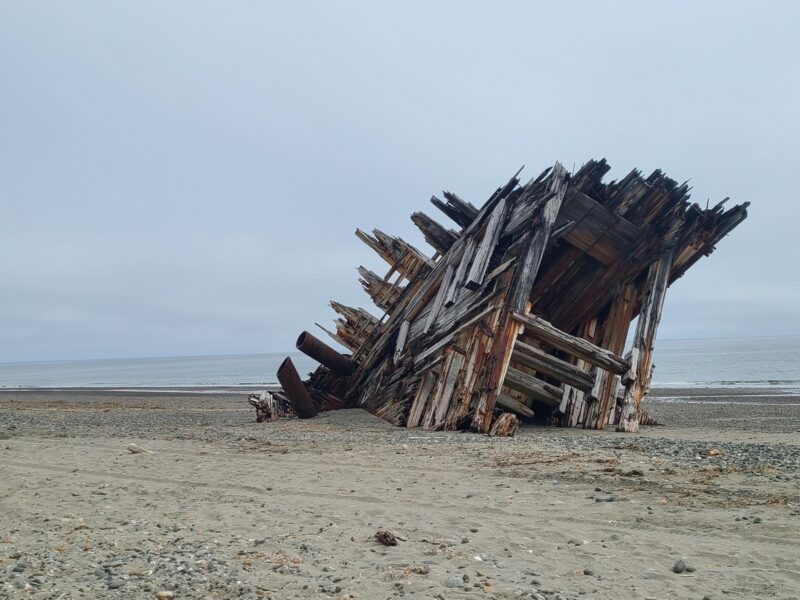
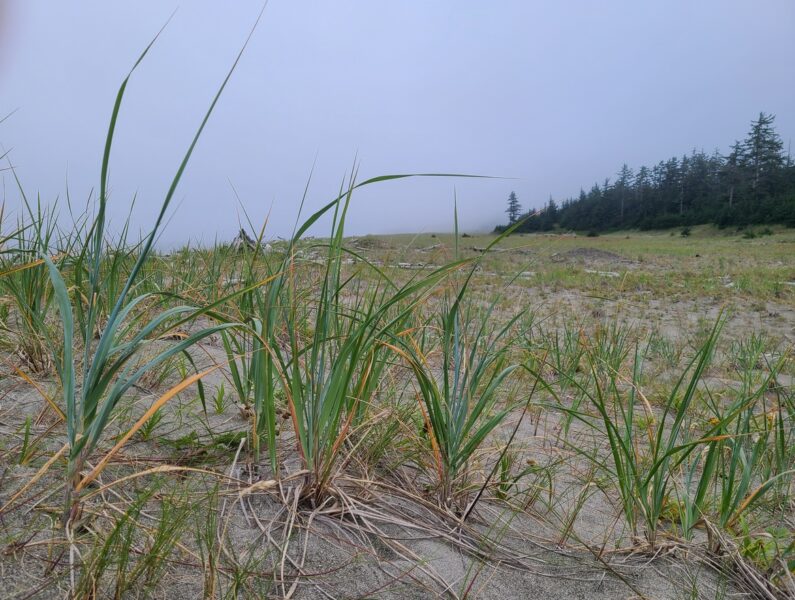
We camped at Misty Meadows, a provincial campsite just outside Tlell. From there, it is a short walk to a quiet beach bordered by dune grass that protects the sand dunes. Nearby we wandered through a spruce forest blanketed with thick moss ten kilometres along the Tlell River to the Pesuta shipwreck, a local attraction. We passed people fishing along the lazy and tannin-rich Tlell river estuary. There was even a woman casting a line from a paddleboard, two dogs lying on the board beside her.
After such a busy time at home getting ready to leave on this trip, Warren and I spent these couple of days getting accustomed to a new relaxed sense of time. As recent empty-nesters, we appreciated that there was no one to worry about but ourselves. All we had to do was plan our next move, eat and take down or set up camp. We felt a sense of bonding, working together on a joint mission without the usual distractions of our lives at home.
Our next leg put us on a perfectly straight and almost flat highway heading east to Port Clements, a stop half-way to Masset. This is also where the famed Golden Spruce trail is. As its more industrial-sounding name suggests, Port Clements is a base for logging and fishing. These two jobs have had much bigger heydays before. A nod to this past is the name of the only restaurant and pub, “Axe and Anchor”.
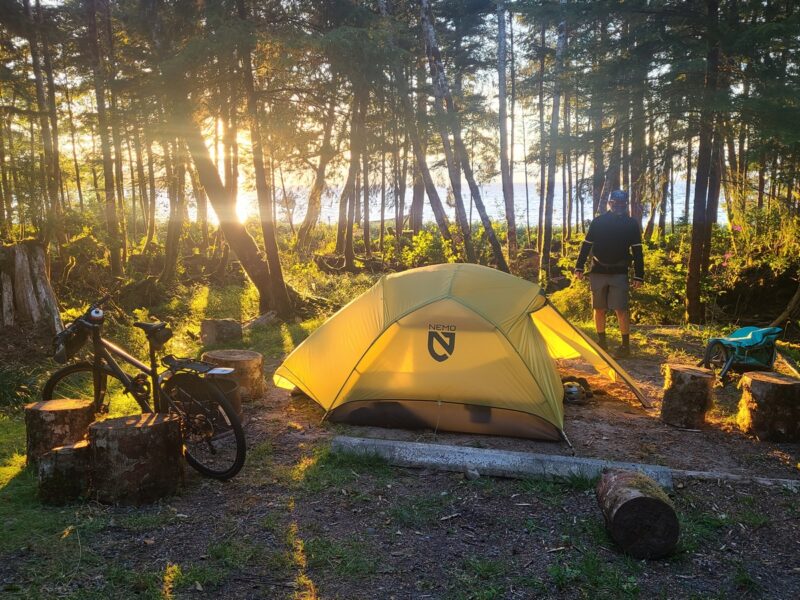
We camped at the rustic village campground situated on the edge of the wide-open space of the Yakoun River estuary, a prime bird-watching area. We set up our tent in a spot that Warren – who is a biologist – thought might be “tide-influenced, (meaning a bit wet at high tide) due to the proximity of the sedge grass. We were greeted by a local named Dave, a somewhat despondent, gray-haired man in a thick plaid shirt. Dave lived nearby, I guessed alone, and liked to do his rounds of talking to campers. We learned how he used to do various jobs in the logging industry there, including a stint as a tugboat operator. He shared his disenchantment with local politics, commented on the lack of workers for the local pub or grocery store (no one wants to work these days) and thought the NDP and First Nations were trying to kill the economy.
Down the road from the campground, the road turns to gravel and will take you to Rennell Sound, which we heard was very beautiful, but more suited for 4 x 4 trucks or much hardier bike-packers. It also leads to the “Golden Spruce” trail, which we decided to check out once our camp was set up. After riding about five kilometres, we turned the last corner and saw a mirage. Actually it was a full-size purple tour bus that looked like it had gotten lost on its way to a casino in Vegas.
I then remembered that this was the same bus I had watched from the top deck of the ferry, very slowly and carefully back it’s way onto the boat. All vehicles are asked to back down the ramp onto the ferry to Haida Gwaii. This is because it only has one opening and you must drive out the same way. If you don’t think you can do it, a ferry worker will do it for you. The bus was carrying about thirty seniors on a tour from Edmonton.
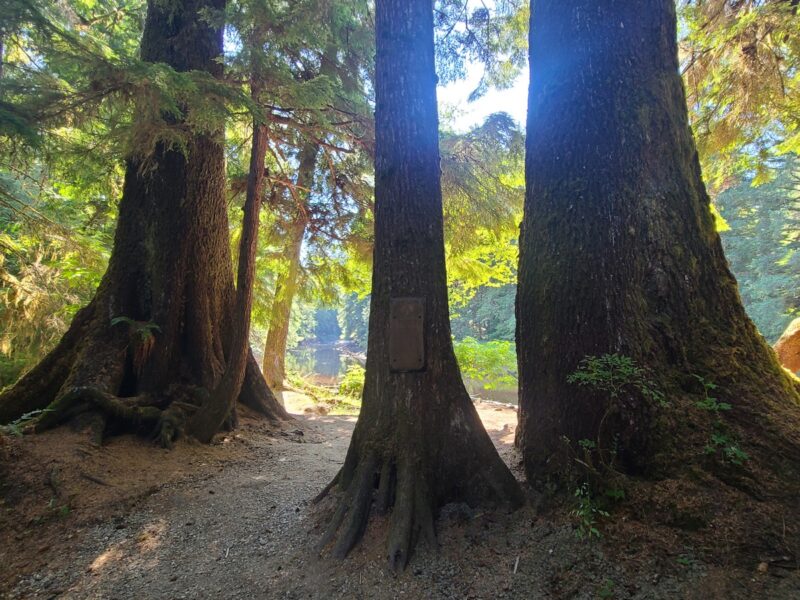
The Golden Spruce was a sacred tree to the Haida, having a genetic variation that gave it golden needles. It was cut down in an unfortunate and strange act of environmental protest, the subject of a book written by John Valliant. You don’t actually see the stump on the trail. But the trail winds around impressive old-growth spruce, ending at the tannin-rich Yakoun River. This long and winding river was a favourite fishing spot for the Haida since time immemorial. Warren was excited to be going to a river so he could swim. But he ended up disappointed as once in the water, he became irresistible prey to hoards of hungry horseflies. It was a futile attempt at cleanliness.
After a couple of nights, we left the muggy warmth of Port Clements for a cooler Masset, and eventually North Beach, the northern tip of Haida Gwaii. We would return to Port Clements in a few days. In Masset, we splurged for a private campground with showers, and laundry and wifi, simple luxuries we had been without for several days by this point. We also had delicious beer (from the Wheelhouse Brewery in Prince Rupert) and maybe the best halibut burger I ever had at The 626 Fish and Chipper food truck.
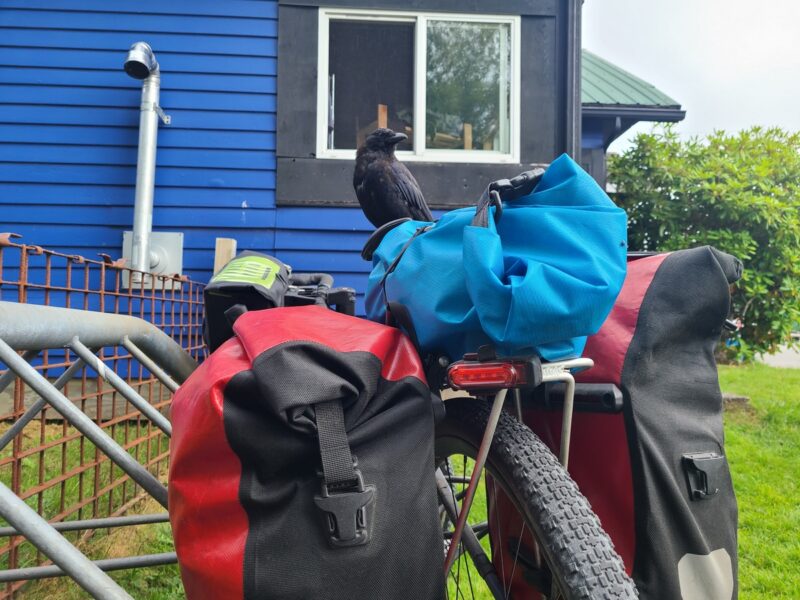
Fortified by showers, clean clothes and pub food, we ventured northwest past the airport and CFB Masset, until the paved road turned to gravel. This is where we discovered that the BOB trailer Warren was pulling wasn’t really designed for bumpy logging roads. It was also getting windy and a bit misty on and off. We checked out Agate Beach, a beautiful provincial campground on the beach, but because of the wind, we forsook it (and the chance to look for agates) for the more sheltered and Haida-owned Hiellen Campground a little further along.
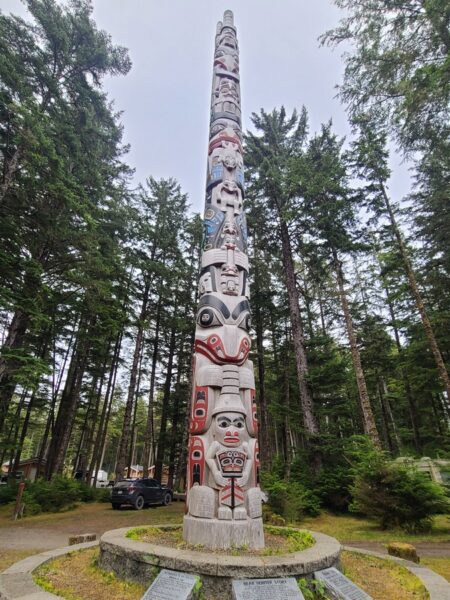
Hiellen was once the site of a large village due to its proximity to a healthy salmon run and abundant razor clams in the tidal flats. For a short time (1923-31) a razor clam cannery even operated here (which destroyed a bunch of archeological features). In 2017 an 18-metre totem pole was erected, carved by apprentices under master carvers Jim Hart and Christian White, the first in the area in 200 years.
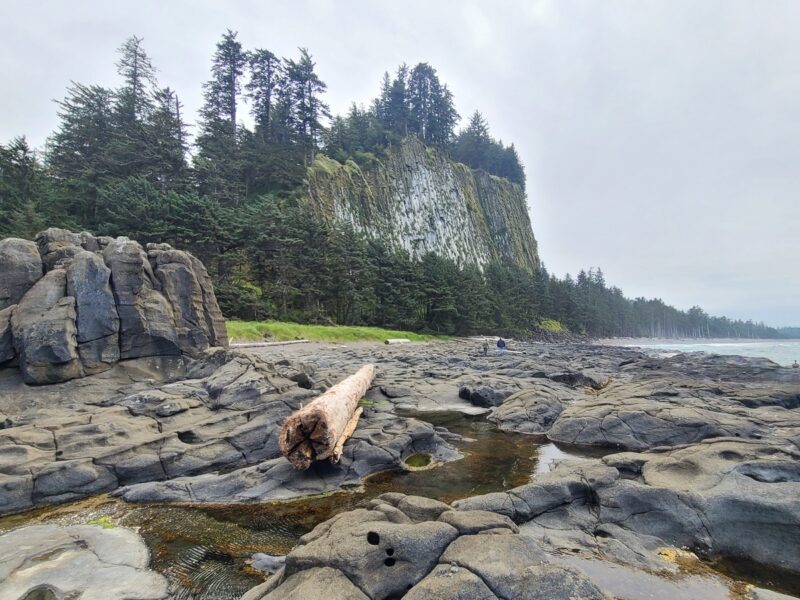
The actual Tow Hill is a basalt stone rock promontory that conspicuously juts out of the land, which served to help with navigation and defense. A sturdy boardwalk leads to the trail to the top where you get sweeping views of the surrounding beaches (signs recommend you keep your dog on a leash). You can also see Rose Spit, the very tip of the island, where Haida tradition says the Raven discovered the first human beings emerging from a clamshell. At the bottom of Tow Hill is the blow hole, where, when the tide is right, the waves are forced through a narrow passage, shooting water into the air. A good friend cast her dad’s (an old Prince Rupert fisherman) ashes in this spot twenty years before.
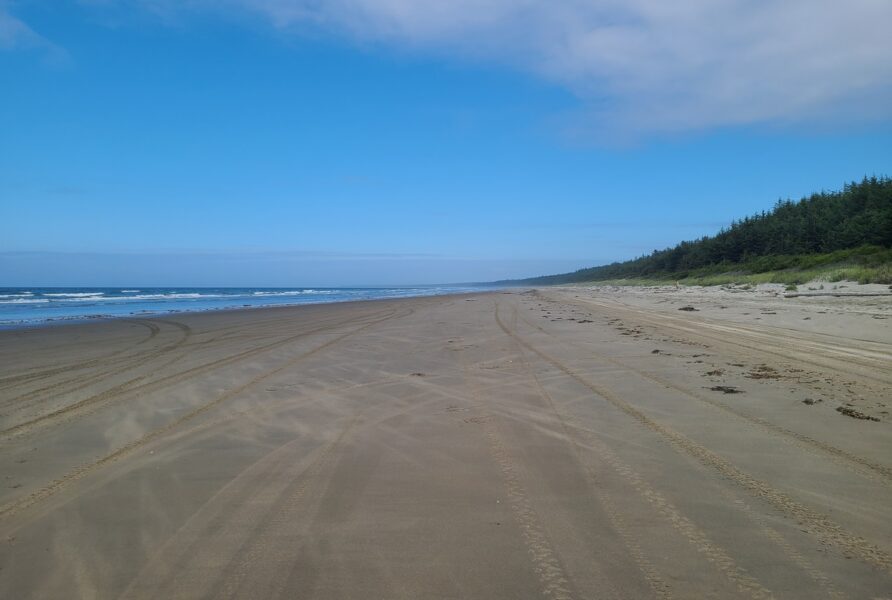
Beyond Tow Hill is North Beach, easily the largest sandy beach I have seen. Walking the length of the beach to Rose Spit, from Hiellen campground (the last road access), would literally take the whole day and you wouldn’t have time to make it back. So people drive their cars or trucks, or ATVs and motorbikes on it; signs say to drive below but near the high tide line. At the beach access, there is a sign with the simple words “Stuck on Beach?” and a phone number below.
Despite the rugged beauty of this place, after a couple of chilly evenings (even with a fire) we were ready to retrace the seventy hilly kilometres to balmy Port Clements. After that it was eighty kilometres, past Tlell to Daajiing Giids, where we would begin the next part of our adventure. This was to include a boat ride in Gwaii Haanas Park, and an excursion on the more remote and rugged Moresby Island, an area where we heard the bear population was very healthy. (Part 3, coming in December 🙂 ) Read Part One, “Arrival” HERE.
Photos (top to bottom): Dune grass at Misty Meadows, Pesuta Shipwreck, Camping at Port Clements, Golden Spruce Trail, Crow on bike in Masset, Tow Hill, North Beach, Totem at Hiellen Camp